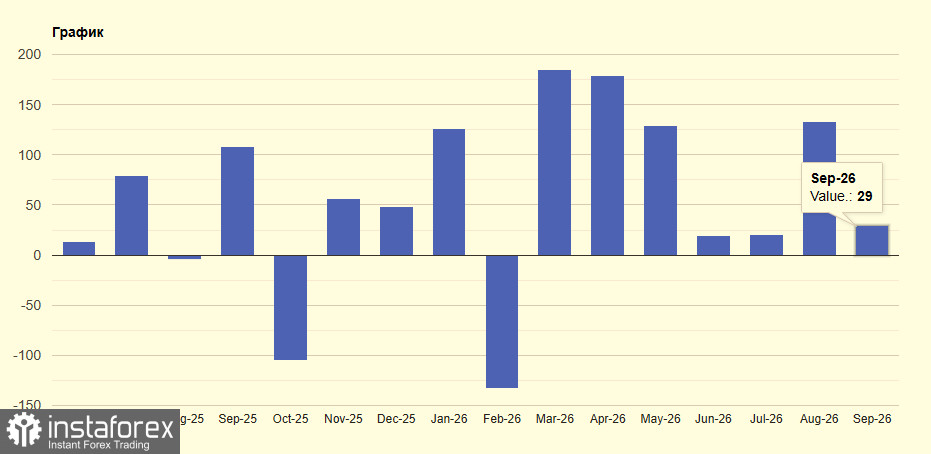
The euro and pound rose against the dollar last Friday after the US September jobs report, but the upswing was short-lived, and the pairs have since resumed declines.
As the report showed, nonfarm payrolls increased by just 29,000, well below the economist consensus of 90,000 and the revised August print of 133,000 (initially reported as 162,000). In addition, July was revised from +21,000 to -10,000. The two-month cumulative revision totaled -60,000. I read these figures as an argument against immediate additional Fed tightening, and the dollar gave back some ground after the release. Revisions made the picture look even weaker.
The unemployment rate ticked up to 4.2% from 4.1%. Labor force participation rose to 61.8% from 61.6%. Average hourly earnings climbed only 0.1% month-on-month to $37.81, while the annual pace slowed to 3.0% from 3.1%. In short, the labor market is not collapsing — it's stalled — and that is trickier for the Fed than a clear downturn because there is no unambiguous signal for aggressive action.
Sector detail shows that the weakness was broad rather than concentrated. Health care added 17,000 jobs versus a 33,000 monthly average for the year; construction added 11,000; manufacturing added 9,000, although it has recovered some 72,000 jobs since its December low. Financials lost 7,000 jobs and are down some 129,000 since the May 2025 peak, with roughly 90,000 of those losses in insurers. The BLS notes that most major sectors saw modest changes, so there is no single obvious culprit behind the weak month.
Wages give the Fed reason to be relaxed. With hourly pay growth slowing to 0.1% m/m and 3.0% y/y, there is no sign of a wage-price spiral. Headline inflation stood at 3.4% y/y, well above the 2% target, which means real household incomes are being squeezed, particularly for consumers paying near-record gasoline and diesel prices. For the Fed, however, the absence of accelerating wage growth weakens the case for immediate tightening. New York Fed President John Williams said in early September that he would support holding the rate in case of continued progress toward our 2% goal. September's data bolsters that dovish view and provides extra ammunition for officials like Williams and Christopher Waller who favor patience.
What about the hawks? Officials such as Beth Hammack, Neel Kashkari, and Lorie Logan voted to raise rates, and Kevin Warsh said in Jackson Hole that the Fed's predominant focus should be on prices. Their view rests on energy, the ISM services prices index at 72.6, and Brent near $105; weak hiring alone does not disprove that logic. It simply weakens the argument that second-round effects have taken hold via the labor market. An October pause would be politically convenient — the Fed meeting falls just days before the November 3 midterms — and President Trump is calling for interest rate cuts, so weak jobs ahead of the vote add political pressure.
For the euro, the picture is constructive. The ECB's deposit rate stands at 2.50% after the September 10 hike, and preliminary September inflation accelerated to 3.8%; markets price in an October move, while the Fed's path appears narrower. Rate expectation differentials are narrowing in the euro's favor. The pound fared worse: it rose with the euro but remains hostage to UK fiscal dynamics — Chancellor John Healey has not ruled out measures that would shrink fiscal buffers to £23.6bn, and the UK labor market is weaker than the US one.
EUR/USD technical outlook
Buyers should consider how to capture 1.1210. Only that would open a test of 1.1259. From there, a move to 1.1307 is possible, but achieving that without support from major players will be difficult. On the downside, expect significant buyer interest only around 1.1165. If bids are absent there, it would be prudent to wait for a drop to a new low at 1.1133 or to open long positions from 1.1097.
GBP/USD technical outlook
Pound buyers need to overcome the immediate resistance level of 1.3225 to target 1.3265. Breaking above that level will be challenging, with 1.3300 as the next extended target. On the downside, bears will try to seize control at 1.3180. A break below that level would deal a serious blow to bulls and could push GBP/USD to 1.3145, with scope to test 1.3110.